1. Introduction
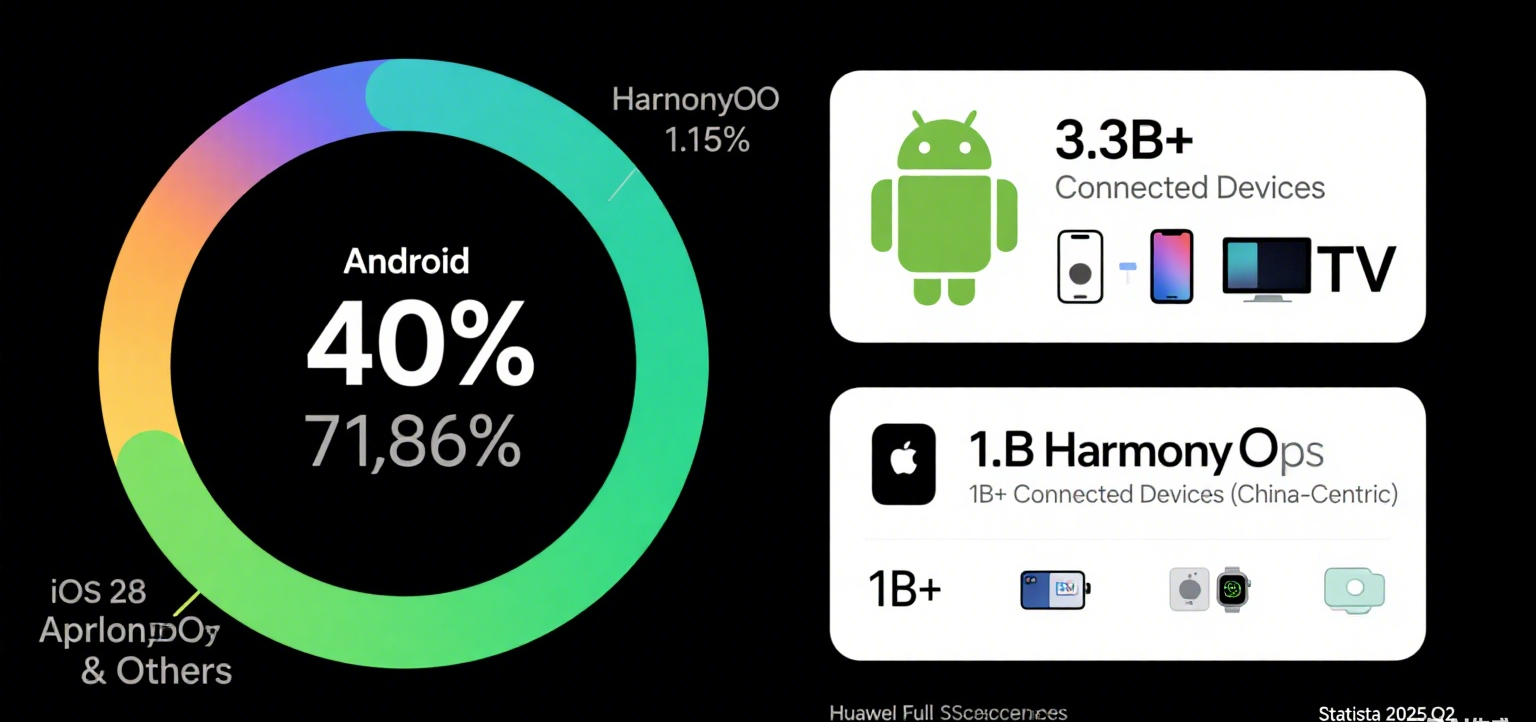
In the dynamic landscape of mobile operating systems, 2025 marks a pivotal moment where three distinct technological philosophies compete for global dominance. Android, with its 71.85% global market share, continues to dominate through its open-source flexibility, powering over 3.3 billion devices worldwide . Apple’s iOS maintains a strong 28% share, leveraging its closed ecosystem’s reputation for security and seamless user experience . Meanwhile, Huawei’s HarmonyOS has emerged as a significant player in its domestic market, with over 1 billion connected devices and rapid growth in native application development . This article explores the fundamental differences between these three operating systems, analyzing their architectural designs, performance metrics, application ecosystems, security frameworks, and user experiences to illuminate how their unique approaches shape modern digital life.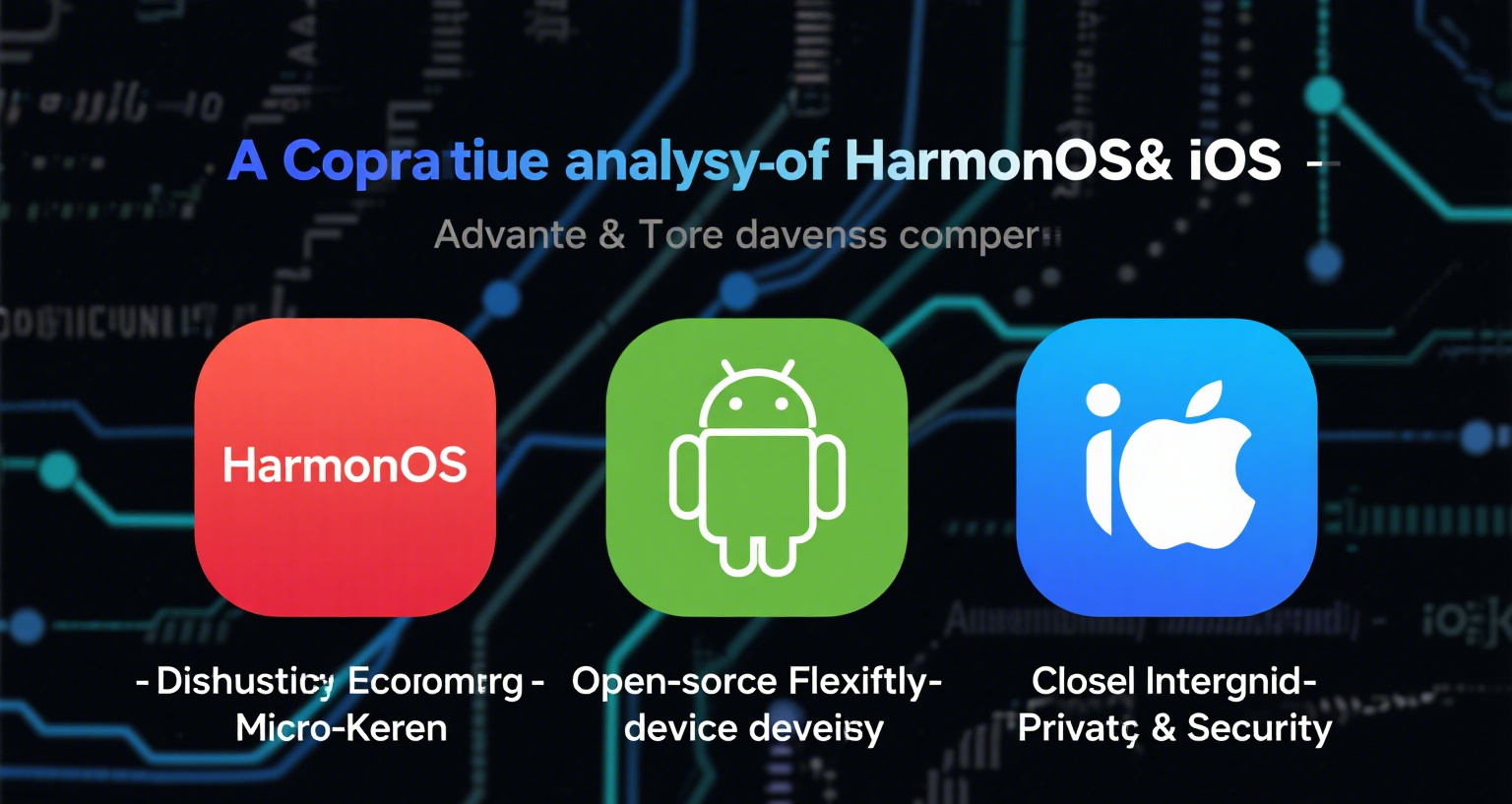
2. System Architecture: Foundations of Design Philosophy
2.1 HarmonyOS: Distributed Micro-Kernel Architecture
HarmonyOS distinguishes itself through its micro-kernel architecture, a departure from the monolithic designs of its competitors. This modular approach isolates core system functions from application services, enhancing both security and stability by limiting the impact of potential vulnerabilities . The micro-kernel contains only essential components like process management and inter-process communication, while other functionalities operate as user-mode services—an architecture that reduces the attack surface for malicious actors.
The most revolutionary aspect of HarmonyOS is its distributed architecture, which enables seamless inter-device connectivity across smartphones, tablets, wearables, and IoT devices. This is facilitated by Huawei’s “Soft Bus” technology, which creates a unified communication framework allowing devices to share resources and collaborate as a single ecosystem . For example, users can initiate a video call on their smartphone and effortlessly transfer it to a smart display while continuing to use the phone as a controller—all without noticeable latency. This distributed capability positions HarmonyOS uniquely for the emerging era of interconnected smart devices.
2.2 Android: Open-Source Linux Kernel
Android’s foundation on the Linux kernel reflects its open-source philosophy, providing manufacturers with extensive customization capabilities. Unlike HarmonyOS’s micro-kernel, Android utilizes a macro-kernel design where most operating system functions integrate directly into the kernel, potentially improving performance through direct resource access but increasing complexity . This architecture has enabled the proliferation of Android devices across price points and form factors, from budget smartphones to high-end tablets and foldables.
The open nature of Android’s architecture allows manufacturers like Samsung (with 22.91% vendor share) to develop custom interfaces such as One UI, while Xiaomi offers MIUI with unique features . However, this flexibility comes at the cost of fragmentation. As of mid-2025, only 38.25% of Android devices run the latest Android 15, with significant portions still on older versions—22.11% on Android 14 and 16.8% on Android 13 . This fragmentation complicates development and security updates, creating a patchwork of user experiences across devices.
2.3 iOS: Closed Integrated Ecosystem
iOS is built on a Unix-like kernel with a closed architecture that exemplifies Apple’s vertical integration strategy. Unlike both HarmonyOS and Android, Apple maintains complete control over both hardware and software, allowing for meticulous optimization between components . This tight integration eliminates the compatibility issues that plague its competitors, ensuring consistent performance across all iOS devices.
iOS architecture prioritizes security through sandboxing—each application runs in its isolated environment with restricted access to system resources and other apps . This design philosophy extends to Apple’s custom silicon, where the A-series chips are engineered specifically for iOS’s requirements. The result is a streamlined architecture where software features like Face ID are deeply integrated with hardware components, creating experiences that are difficult to replicate in more open systems.
3. Performance: Real-World Capabilities and Limitations
3.1 HarmonyOS: Optimized for Distributed Tasks
HarmonyOS demonstrates impressive performance in scenarios leveraging its distributed architecture. Its task scheduling algorithm intelligently allocates processing loads across connected devices, utilizing the most appropriate hardware for specific tasks . For example, when editing a 4K video, HarmonyOS can offload rendering tasks to a more powerful tablet or smart display while using the smartphone as a control interface.
In standard smartphone benchmarks, HarmonyOS devices typically deliver competitive performance, though direct comparisons are challenging due to the lack of widespread third-party testing. Huawei’s Pura X, running HarmonyOS 5, showcases optimized memory management that allows for smooth multitasking even with numerous applications running simultaneously . The system’s response time benefits from reduced background process overhead, a advantage of its micro-kernel design that minimizes unnecessary resource consumption.
3.2 Android: Variable Performance Across Devices
Android performance exhibits significant variability based on hardware specifications and manufacturer optimization. High-end Android devices equipped with Snapdragon 8 Gen 3 processors achieve Geekbench scores around 2050, matching or exceeding many iOS devices in raw computational power . These premium devices offer fluid experiences comparable to flagship iPhones, with advanced cooling systems enabling sustained performance during intensive tasks.
However, the Android ecosystem suffers from inconsistent performance across its vast device range. Budget devices often struggle with lag and slowdowns, particularly after several months of use, as manufacturers prioritize new releases over long-term optimization . This disparity stems partly from Android’s resource management approach, which allows more background processes to run continuously, consuming memory and battery life. While recent Android versions have improved memory management, the fragmentation issue means many users never receive these optimizations.
3.3 iOS: Consistent Performance and Longevity
iOS is renowned for its consistent performance, achieved through Apple’s comprehensive control over hardware and software. Even mid-range iOS devices like the iPhone SE deliver smooth experiences due to meticulous optimization . Flagship iPhones with A17 Pro chips demonstrate exceptional performance in Geekbench tests, though specific 2025 figures remain comparable to top Android devices in single-core tasks, where iOS traditionally excels.
A key advantage of iOS is its performance longevity. Apple’s software updates include performance optimizations specifically tailored for older devices, extending their usable lifespan . This contrasts with the common experience of Android devices, which often become noticeably slower after 18–24 months. iOS’s efficient memory management system minimizes background resource usage, ensuring that even devices with lower RAM configurations maintain responsiveness during daily use.
4. Application Ecosystems: Quantity, Quality, and Accessibility
4.1 HarmonyOS: Rapid Domestic Growth with International Challenges
HarmonyOS has made significant strides in building its native application ecosystem, particularly in China. As of 2025, over 20,000 native apps span 18 industries, with major Chinese tech companies like Tencent, Alibaba, and Bytedance developing dedicated HarmonyOS versions of their services . This growth has been supported by Huawei’s extensive SDK libraries and developer incentives, resulting in comprehensive coverage of daily-use applications within the Chinese market.
Internationally, however, HarmonyOS faces substantial challenges. The absence of Google Mobile Services (GMS) remains a critical barrier, as popular applications like YouTube, Instagram, and WhatsApp rely on Google’s frameworks . While Huawei offers the “Easy Abroad” emulator allowing limited Android app functionality, this solution has limitations: apps cannot be placed on the home screen, and notification reliability is inconsistent . This emulator uses MicroG, an open-source alternative to GMS, but compatibility issues persist with many popular services.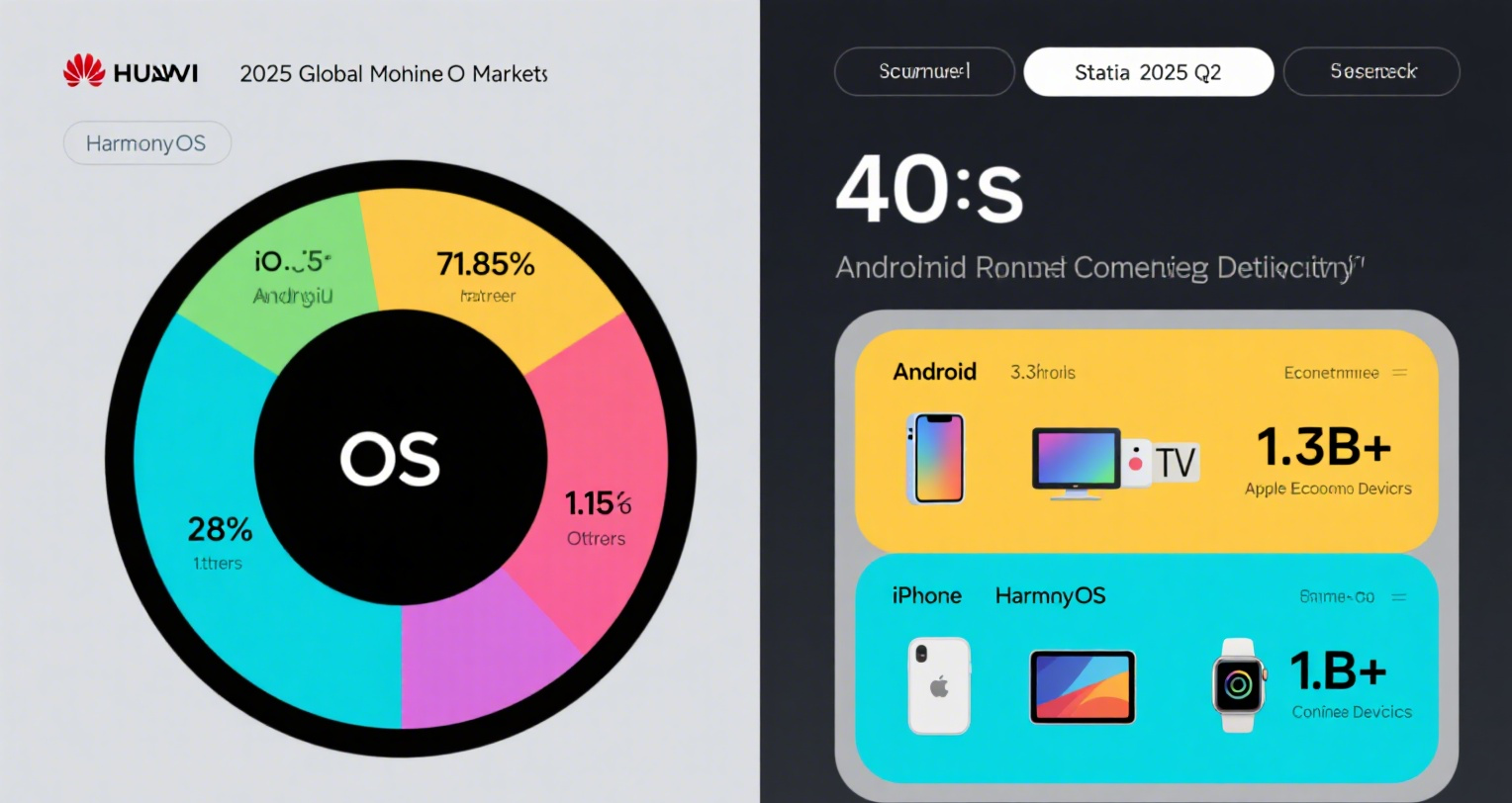
4.2 Android: Vast Quantity with Quality Variability
Android’s application ecosystem is the largest and most diverse, with the Google Play Store hosting 1.68 million apps as of 2025 . This extensive library covers virtually every imaginable use case, from specialized professional tools to niche entertainment applications. The open nature of Android allows developers to experiment with innovative features and monetization models, fostering rapid innovation.
However, this quantity comes with quality trade-offs. The Google Play Store’s relatively permissive review process results in a higher incidence of low-quality, redundant, or potentially malicious applications compared to iOS . Android users must exercise greater discernment when selecting apps, relying heavily on ratings and reviews. Additionally, app performance varies significantly across devices due to hardware differences and OS versions, with some applications optimized only for flagship models.
4.3 iOS: Curated Quality with Restricted Flexibility
The Apple App Store maintains a more curated approach, with approximately 1.8 million applications as of 2025 (though exact figures vary by source). Apple’s strict review process ensures higher overall app quality, with fewer low-effort or malicious applications slipping through . This curation extends to design consistency, as apps must adhere to Apple’s Human Interface Guidelines, creating a more unified user experience across applications.
iOS users benefit from better-optimized applications, as developers can target a more limited range of hardware configurations . However, this ecosystem flexibility comes at the cost of flexibility. Apple’s restrictive policies prohibit certain app types and functionalities, such as custom launchers or system-level automation tools available on Android . Additionally, iOS applications often lag behind their Android counterparts in adopting new features, as developers must wait for Apple’s annual SDK updates and subsequent approval process.
5. Security and Privacy: Protection Mechanisms and Vulnerabilities
5.1 HarmonyOS: Architecture-Based Security with Growing Concerns
HarmonyOS’s micro-kernel architecture provides a foundational security advantage through component isolation, limiting the potential impact of security breaches . The system implements robust encryption for both data at rest and in transit, with dedicated hardware security modules protecting sensitive information like biometric data.
Recent security assessments have identified several vulnerabilities in HarmonyOS, including permission bypass issues in the window management module and memory management flaws . While concerning, these vulnerabilities appear less frequent than those in Android’s more complex codebase. Huawei’s security response team has demonstrated efficiency in issuing patches, though the rollout speed varies across device models.
In terms of privacy controls, HarmonyOS offers granular permission management, allowing users to control app access to sensitive data . However, its privacy features lack the sophistication of iOS’s latest implementations, particularly in areas like data minimization and tracking prevention, where HarmonyOS is still developing capabilities.
5.2 Android: Evolving Protections Hindered by Fragmentation
Android has significantly improved its security infrastructure, with Google Play Protect scanning over 10 billion apps daily for malware . Recent versions introduce advanced features like scoped storage, which limits app access to system files, and a privacy dashboard that provides transparency into app permission usage . Android 15 further enhances these protections with improved sandboxing and runtime exploit mitigation.
The primary security challenge for Android remains version fragmentation. As of 2025, over half of all Android users operate on versions no longer receiving security updates, including 15.9% on Android 11 and 10.2% on Android 10 . This leaves hundreds of millions of devices vulnerable to known exploits. Manufacturer-specific customizations often introduce additional vulnerabilities, as seen in multiple UI-specific security flaws reported in 2025 .
Android’s privacy controls have evolved to offer granular permissions, but their effectiveness is undermined by inconsistent implementation across devices and manufacturers . While Android 15 introduces enhanced tracking prevention, many users cannot access these features due to slow update rollouts.
5.3 iOS: Industry-Leading Privacy with Centralized Control
iOS continues to set the standard for mobile privacy, with iOS 18 introducing groundbreaking features like granular contact permissions that allow users to share specific contacts rather than entire address books . This builds on existing protections such as App Tracking Transparency, which requires apps to obtain explicit permission before tracking user activity across other services.
Apple’s Secure Enclave technology provides hardware-level encryption for biometric data and sensitive information, with encryption keys never accessible to software or Apple itself . The company’s privacy-focused business model—relying on hardware sales rather than data monetization—aligns with strong protective measures that minimize data collection by default.
iOS security vulnerabilities are relatively rare and quickly addressed through expedited update rollouts . The closed ecosystem ensures that security patches reach nearly all devices within days, with over 80% of iOS users typically running the latest version within months of release. This centralized approach eliminates the fragmentation issues plaguing Android security.
6. Update Support and Longevity: Sustained Performance Over Time
6.1 HarmonyOS: Extending Lifespan for Older Devices
Huawei has made significant commitments to extending the lifespan of HarmonyOS devices. In 2025, the company announced plans to provide HarmonyOS 5.0 updates to smartphones released as early as 2019, potentially adding 200–300 million devices to its ecosystem . This aggressive update policy reflects Huawei’s strategy to build ecosystem scale amid international challenges.
The HarmonyOS update process varies by device, with flagship models receiving priority. The Mate 70 series and Pura X received day-one updates to HarmonyOS 5, while older devices follow a phased rollout schedule . Huawei’s focus on older devices demonstrates a user-centric approach but raises questions about whether aging hardware can fully leverage new software features without performance degradation.
6.2 Android: Inconsistent Support Across Manufacturers
Android update support remains highly variable, with flagship devices from major manufacturers typically receiving 2–3 years of OS updates, while budget models often get only 12–18 months . Samsung has improved its commitment, offering 4 years of OS updates for recent flagships, but implementation remains inconsistent.
As of mid-2025, only 38.25% of Android devices ran the latest Android 15, with Android 14 (22.11%) and older versions still prevalent . This fragmentation results from the complex update process, which requires modifications by both chipset vendors and device manufacturers before carrier approval in many markets. The result is a ecosystem where users of identical hardware may experience dramatically different support lifespans based on region and carrier.
6.3 iOS: Unmatched Update Consistency
iOS maintains industry-leading update support, with Apple providing 5–6 years of OS updates for all iPhone models . The iPhone 12 series, released in 2020, continued to receive significant updates in 2025, a level of support unmatched by any Android manufacturer.
Apple’s ability to deliver consistent updates stems from its vertical integration—controlling hardware, software, and chip design allows for streamlined testing and deployment . Updates roll out simultaneously to all compatible devices worldwide, with a straightforward installation process that requires minimal user intervention. This commitment to longevity significantly enhances the total value proposition of iOS devices, offsetting their higher initial cost.
7. User Experience: Interface Design and Ecosystem Integration
7.1 HarmonyOS: Seamless Cross-Device Interaction
HarmonyOS redefines user experience through its distributed capabilities, enabling seamless interaction across devices. Its “super device” feature allows users to connect multiple HarmonyOS devices into a unified system, where applications and data flow between screens based on context and usage patterns . For example, a document started on a smartphone can automatically appear on a tablet when nearby, with editing continuity preserved.
The HarmonyOS interface balances simplicity with advanced functionality, featuring customizable home screens and a control center optimized for quick access to frequently used features . Its AI-driven smart suggestions anticipate user needs, such as displaying navigation apps when leaving home or suggesting music based on time and location.
However, HarmonyOS’s user experience can feel less polished than its competitors in some areas, particularly in third-party app integration . The reliance on emulated Android apps for international users creates inconsistencies in interface design and functionality.
7.2 Android: Customizable but Inconsistent
Android offers unparalleled customization, allowing users to modify nearly every aspect of the user interface from launchers and icon packs to system fonts and animations . Manufacturers like Samsung and Xiaomi provide extensive theme engines and customization options, enabling users to create highly personalized experiences.
This flexibility comes at the cost of consistency. Interface design varies dramatically between manufacturers and even between devices from the same brand, creating a steep learning curve when switching devices . Core system features like notification management and settings organization differ significantly across Android implementations.
Android excels in productivity features, with advanced multitasking capabilities, split-screen functionality, and deeper integration with Google services . However, the user experience often suffers from feature overload, with manufacturers adding redundant apps and services that consume resources and complicate the interface.
7.3 iOS: Polished Consistency with Restricted Customization
iOS delivers a meticulously polished and consistent user experience across all devices, with intuitive navigation patterns that remain familiar across versions . The interface prioritizes simplicity and accessibility, with a clean design language that minimizes clutter and cognitive load.
While iOS offers limited customization compared to Android, recent versions have introduced more personalization options, including widget customization and app library organization . These changes strike a balance between Apple’s design philosophy and user demands for personal expression.
The seamless integration between iOS devices—including iPhones, iPads, Macs, and Apple Watch—creates a cohesive ecosystem where data and functionality flow effortlessly . Features like Handoff, Universal Clipboard, and AirDrop set iOS apart in terms of cross-device convenience, though this ecosystem is limited to Apple’s own hardware.
8. Conclusion: Choosing the Right Ecosystem for Your Needs
The choice between HarmonyOS, Android, and iOS ultimately depends on individual priorities, usage patterns, and geographic location. HarmonyOS represents the most innovative approach to distributed computing, excelling in multi-device integration and offering exceptional value in the Chinese market where its native app ecosystem is comprehensive . Its aggressive update policy and hardware longevity make it an attractive option for users seeking long-term value, though international users will face limitations with popular Western applications.
Android remains the most versatile choice, offering unparalleled customization and device variety across price points . It is particularly well-suited for power users who value flexibility, tech enthusiasts who enjoy modifying their devices, and users in emerging markets where budget options are essential. However, Android users must carefully select devices from manufacturers with strong update commitments to ensure long-term security and performance.
iOS continues to set the standard for privacy, security, and consistent user experience, with unmatched update support and seamless ecosystem integration . It appeals to users who prioritize simplicity, security, and reliability over customization, as well as those invested in other Apple products. While iOS devices typically command premium prices, their longevity and consistent performance justify the investment for many users.
Looking to the future, these operating systems are increasingly converging in core functionality while doubling down on their unique strengths. HarmonyOS’s distributed architecture may influence broader industry approaches to multi-device interaction, while Android continues to refine its security and privacy capabilities. iOS will likely maintain its focus on user-centric design and privacy innovation. As the mobile landscape evolves, each platform’s ability to adapt to emerging technologies like AI, AR, and IoT while addressing their respective weaknesses will determine their long-term success in the global marketplace.
声明;本站所提供的资源均来自互联网,仅作为收集整理,不对其准确性、真实性、可用性和合法性做出保证。本站所提供的所有资源仅供学习参考、思路扩展和技术借鉴之用。如果您需要使用这些资源,请自行寻找渠道获取正版资源。 虚拟物品具有复制性和可传播性,我们无法控制其使用方式。一旦您下单购买虚拟物品,我们不接受任何退换货理由,请您谨慎考虑后下单购买。如果在资源使用过程中侵犯了您的权益,请您理解,并请联系我们24小时内处理,联系邮箱为:281679559@qq.com。 谢谢理解和支持!